Process Improvement
- Decision rights are disputed
- Evidence has no reliable owner
- Exceptions have no route
A decision guide for procurement leaders: select the right workflows, set action limits and human approvals, and prove business value before wider deployment.
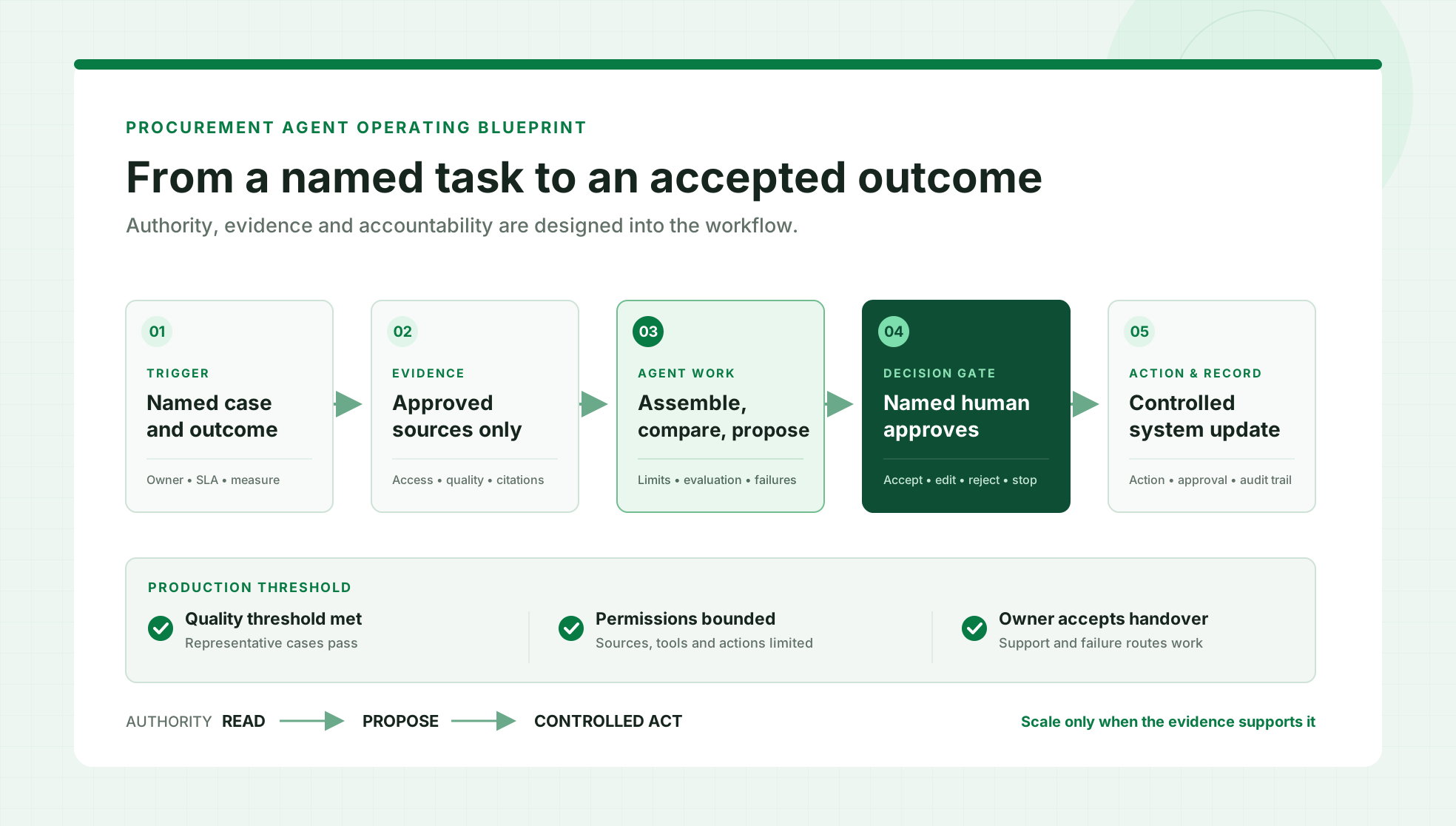
A procurement agent is useful when it takes responsibility for a bounded work step: assembling source material, applying stated rules, preparing a recommendation, using an approved tool, or coordinating the next action. A general assistant becomes part of an operating model only when its task, source records, actions, and accountability are defined.
The investment case should fit on one page. Name the business result, the work being delegated, the evidence the agent may use, the actions it may take, the person accountable for the decision, and the measure that determines acceptance. If any of those remain vague, the use case is not ready to scale.
Match each procurement problem to the simplest suitable mechanism. This usually produces a cheaper and more reliable service than assigning an agent by default.
Use the workflow conditions to choose between Process Improvement, rules-based automation, and an agent.
A compelling demo does not prove production readiness. Score the implementation conditions before building anything, then compare candidate workflows on the same basis.
An illustrative assessment of one candidate workflow. Replace every score with evidence from your own process.
Keep evaluation scoring and the supplier recommendation with the category lead.
Assess use cases by the value of the business constraint removed. A lower-volume task may be more valuable when it delays a sourcing decision, holds up a contract, or consumes scarce category, legal, risk, or finance capacity.
Representative test results and working controls determine how much authority the agent receives.
The agent retrieves approved evidence, extracts fields, classifies the case, and shows where each material statement came from. This is the right starting point when data access and output quality are still being proven.
The agent compares options, identifies missing evidence, drafts a recommendation, and routes it to the accountable reviewer. The human decision and rationale remain explicit.
The agent updates a record, creates a task, sends an approved communication, or triggers the next workflow step within stated limits. Irreversible, high-value, sensitive, or unusual actions continue to require human approval.
Grant action rights only after the workflow passes representative tests, failure routes work, users understand the review and exception route, and production monitoring is in place.
These figures show how to frame a pilot; they are not TraDuotech client results. Establish your baseline before setting targets.
Model quality is one control point. Procurement leaders also need to govern the task, source material, permissions, tools, decision rights, user review, and production record. NIST’s AI Risk Management Framework separates governance, context mapping, measurement, and ongoing management across the lifecycle.
Each boundary needs an owner, a test and an audit record. Model quality is one part of the control design.
Named case, outcome and completion rule
Approved sources with traceable claims
Instructions, evaluation and failure handling
Least privilege, value and action limits
Approval, override and stop authority
Action history and final disposition
The business remains accountable for decisions made with AI support. Human oversight therefore needs a real owner, enough context to challenge the recommendation, and the authority to stop or reverse the next step.
Base a production decision on representative procurement cases. Build an evaluation set from historical work and deliberately include incomplete submissions, conflicting sources, policy exceptions, unusual suppliers, access restrictions, and cases that should be escalated.
Record hours saved as released capacity. Claim cash savings only when that capacity removes backlog, avoids planned hiring, increases sourcing coverage, accelerates a commercial decision, or improves control performance. Keep each benefit tied to an operational measure and an owner.
Use real case volume, adoption and median touch time. Treat released hours as cash only when they avoid cost or are redeployed to named work.
1,200 cases × 65% eligible × 18 min = 234 hours
Add only benefits evidenced against the baseline
Platform + integration + evaluation + review + support
Report acceptance and override rates beside time saved. A fast agent that users routinely rewrite, bypass, or distrust has moved cost rather than removed it.
Each phase earns the next level of exposure. Revise or stop when a phase misses its evidence gate.
Map the task, evidence and current performance.
GateSigned scope and baselineConnect minimum sources and test representative cases.
GateAcceptance threshold metCompare real work, overrides, failures and run cost.
GateOwner accepts the workRelease defined actions and monitor service measures.
GateScale, revise or stopUse workflow fit, control requirements, integration effort, service ownership, and total cost to choose between an agent in the procurement suite, the organisation’s selected platform, or a separate harness.
These sources inform the governance, human-oversight, evaluation, and lifecycle recommendations in this guide.
Procurement Signals
Ethics & Compliance: Embed Controls Into Procurement and Third-Party Workflows
A CECO-focused implementation guide for faster, proportionate and reviewable controls across S2C, S2P and third-party risk.
Procurement Signals
Procure-to-Pay (P2P): Stabilise Controls, Cut Exceptions, Then Automate
A stabilisation playbook that treats invoice exceptions as signals and links cycle-time and control measures to corrective action.
Procurement Signals
Spend Management: From Visibility to Behaviour Change
An operating model that connects demand, guided buying, policy decisions and category action to measurable spend outcomes.
A lightweight quarterly note with practical playbooks and patterns. No spam.
Practical patterns for procurement delivery, agentic systems, and GTM execution.